

School culture is built from hundreds of daily decisions — how staff speak to students, how achievement is recognised, how different needs are accommodated. But there's a quieter set of decisions that shapes culture just as consistently, made long before the school year starts. The furniture a school chooses, how it's arranged, and how well it's maintained sends a continuous ambient message to everyone who walks through the door. The University of Salford's HEAD Project found that physical classroom environment accounts for 16% of the variation in pupil progress. Furniture is one of the most direct and accessible parts of that environment to change. This article covers what school furniture communicates and how to make it communicate deliberately.
What the furniture communicates before anyone speaks
The physical environment a school provides communicates, wordlessly and continuously, what the institution thinks of the people inside it. A school that invests in well-chosen, well-maintained furniture tells its students that their comfort, their focus, and their experience matters. A school with tired, mismatched, or broken furniture — however unintentionally — sends the opposite.
This isn't about expensive furniture. It's about intentional furniture. The correlation between the physical quality of a school environment and student behaviour, pride, and sense of belonging is consistent across research. Students who feel valued in their environment are more likely to treat it with respect. That dynamic starts with the decision to take the environment seriously — and the furniture is the most visible, tangible part of that decision.
The right starting question for any school furniture brief is not 'what do we need?' It is 'what do we want this space to say to the people who use it?' The answer should drive every subsequent specification decision.
Flexible classroom furniture embeds collaborative values
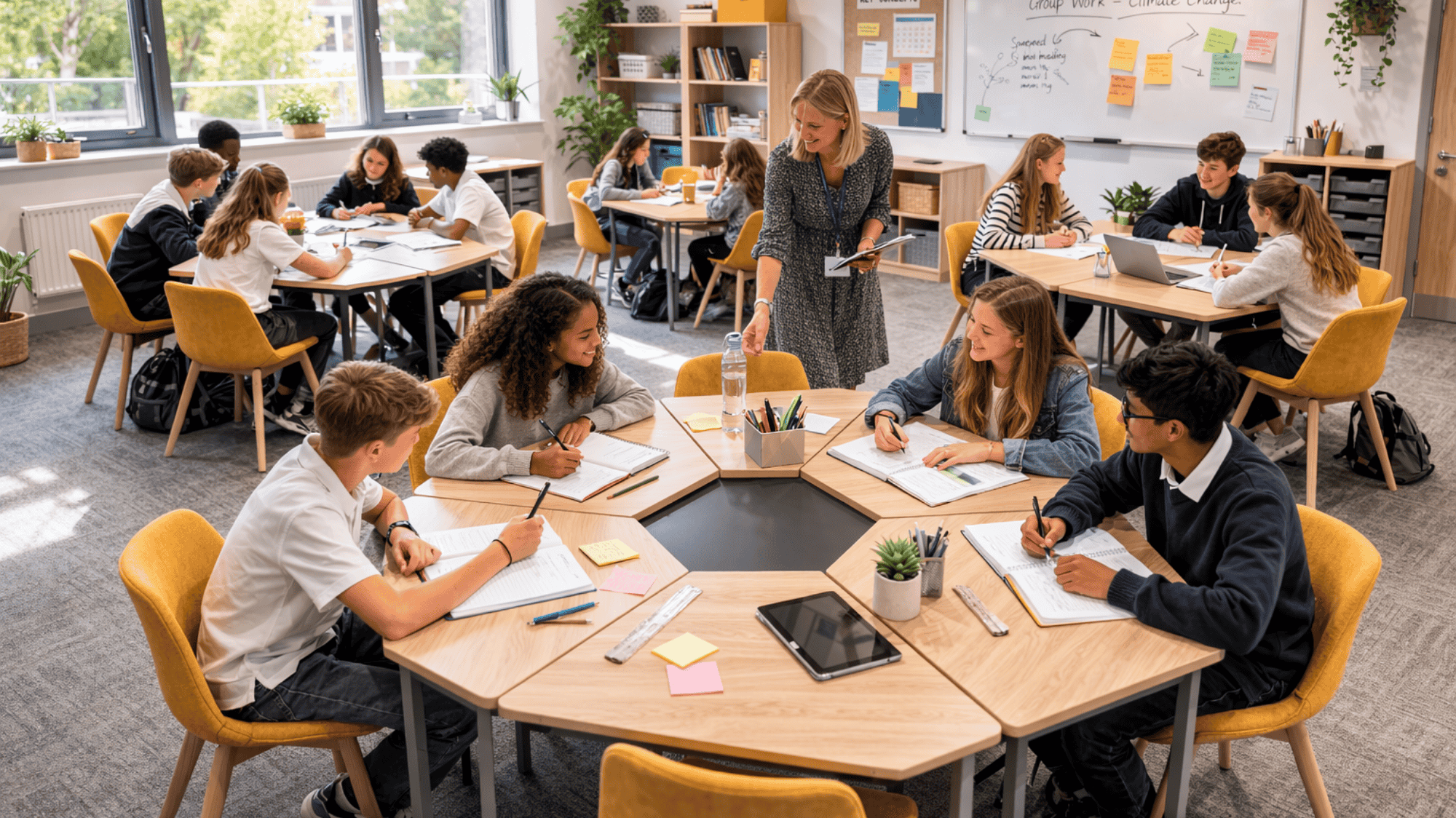
The arrangement of classroom furniture is one of the most direct physical expressions of a school's pedagogical values. A room in fixed rows facing the front communicates a particular model of learning: hierarchical, teacher-centred, transmission-based. A room where lightweight tables and chairs can be rearranged into pairs, groups, horseshoes, or clusters communicates something different — that learning is participatory, that student voice matters, and that different tasks call for different configurations.
Schools serious about collaborative or enquiry-based learning need classroom furniture that can physically support those approaches without significant friction. The three-minute reconfiguration test applies here: if moving from rows to groups takes ten minutes and generates noise and disruption, teachers stop doing it. The room settles into one arrangement. And the pedagogy that requires flexibility quietly disappears from the repertoire.
Tables under 10kg for primary and under 15kg for secondary, with quiet glides matched to the floor surface, make reconfiguration a two-minute student-led activity rather than a lesson-disrupting exercise. Trapezoidal tables that combine into hexagonal clusters without gaps give teachers access to configurations that rectangular tables can't support. The furniture is not neutral here — it either enables the teaching approach or constrains it.
Inclusive furniture makes belonging tangible
A school's commitment to inclusion is only as real as its practical expression — and furniture is one of the most practical expressions available. Inclusive school furniture means ensuring every student has access to seating and working surfaces that fit their body correctly, regardless of their size, physical need, or learning requirement.
In specification terms, this means:
- EN 1729 sizing across the full range of student heights — so smaller students aren't perching on furniture designed for older pupils, and taller students aren't hunched over desks that are too low. An EN 1729 size 3 chair has a seat height of 350mm; a size 5 is 430mm. The difference is not cosmetic — it determines whether the student is physically comfortable for the duration of a lesson.
- Height-adjustable furniture and specialist seating for students with physical needs integrated as a standard part of the classroom, not a visible add-on that singles students out. The goal is furniture that fits every student without drawing attention to who needed the accommodation.
- Sensory-aware specification: seating that doesn't creak disruptively on movement, surfaces in calm finishes that don't create visual overwhelm, furniture that doesn't wobble or shift unpredictably. For students with sensory processing differences, these are not minor comfort details — they are the difference between a manageable and an overwhelming learning environment.
When inclusive furniture is specified thoughtfully, it becomes invisible. Every student simply has furniture that works for them. That invisibility is what genuine inclusion looks like in a physical environment.
Library and social spaces: where culture is lived
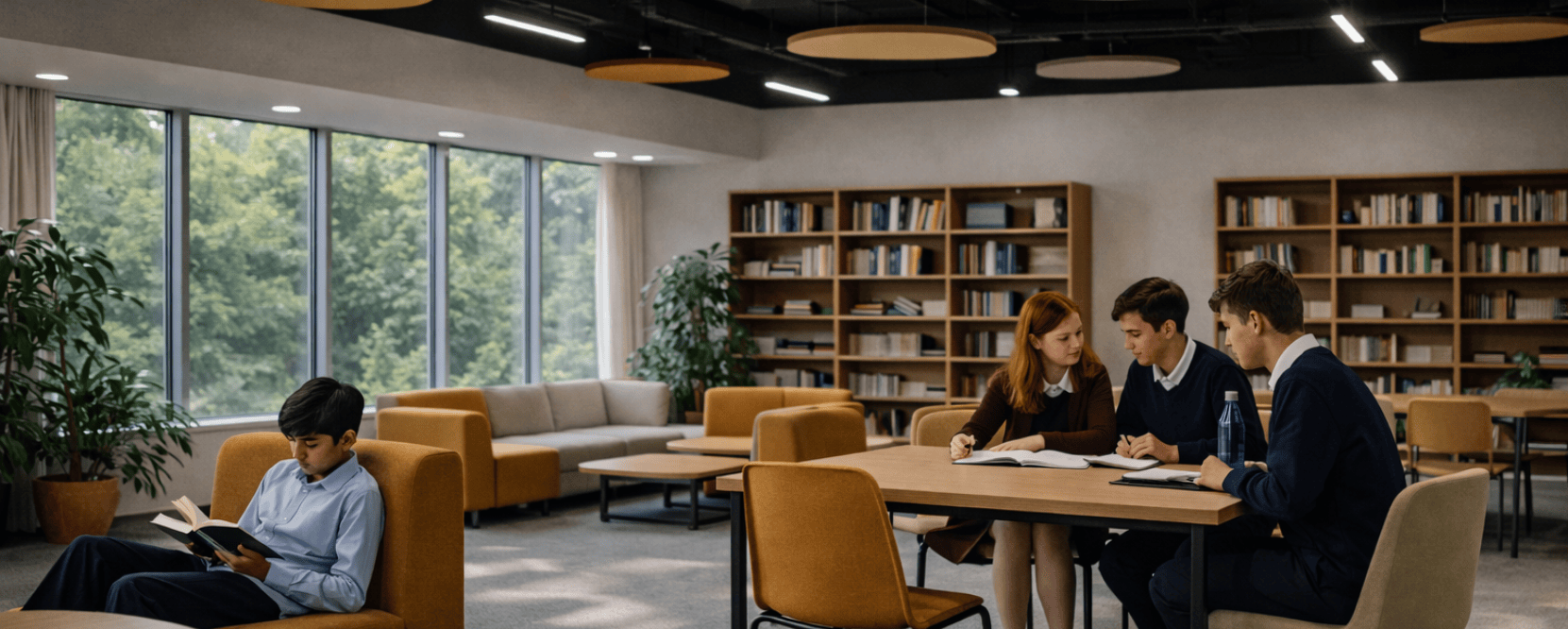
If classrooms are where school culture is taught, libraries and social spaces are where it's lived. The furniture in these environments shapes what students choose to do with their time — and those choices accumulate into habits, relationships, and a sense of what kind of place the school is.
A school library with varied, comfortable furniture — soft seating for quiet reading, collaborative tables for group study, individual carrels for focused independent work — invites students to use it in genuinely different ways. It signals that the library belongs to all of them, not just students who already identify as readers. A library with uncomfortable seating and no variety in its arrangement communicates, subtly but effectively, that it is a functional space rather than a welcoming one. Students make their choices accordingly.
School dining furniture carries the same weight. The dining hall is where students decompress between lessons, build friendships, and develop the sense of community that underpins belonging. Dining furniture that is comfortable and maintained, arranged to facilitate genuine social interaction rather than to maximise throughput, creates an environment students want to spend time in. That willingness to be present in shared spaces is itself a cultural indicator.
Staff furniture signals that teacher wellbeing matters
School culture is not only about students. The environment provided for staff is an equally powerful cultural signal — and one that is frequently underinvested. A staffroom with worn-out furniture, inadequate work surfaces, and seating that hasn't been updated in a decade tells staff that their comfort and wellbeing is secondary. The consequences are real: staff who don't feel valued in their physical environment are less likely to feel valued by their institution, and that affects morale and retention.
A well-furnished staff environment — quality seating in the staffroom, practical and ergonomic workspaces in preparation areas, social furniture that makes breaks feel genuinely restorative — communicates that the school takes its staff seriously. A positive school culture has to be experienced by the people who build it, not just the students who benefit from it.
Colour, palette, and the coherent school environment
The aesthetic choices in school furniture specification — colour, material, finish — contribute directly to the character of the environment and the culture it communicates. These are not superficial decisions. The University of Salford's HEAD Project identified colour saturation as a measurable factor in pupil progress: excessive visual stimulation creates cognitive load that competes with learning. Calmer, more considered palettes in classroom furniture support focus; warmer, more varied finishes in social and library spaces encourage relaxation and informal connection.
Many schools incorporate their identity into their furniture specification — using school colours as accent tones on chair shells, table frames, or upholstery. Done with restraint, this creates a genuine sense of place and belonging. The test: will this still look considered in year five, or will it look like a trend that passed? Furniture colour choices should be made for the long term, not the launch photos.
Durability is the cultural commitment that sustains all the others
A school can make every right decision in its furniture specification and still undermine its cultural investment if the furniture doesn't last. Furniture that degrades quickly, that looks worn within two or three years of installation, sends a demoralising message: that the school's investment in its environment wasn't serious, or that it didn't extend to maintaining it. Students and staff notice when things deteriorate. Those observations shape how they feel about the institution.
Durable school furniture — specified to EN 16139:2013 for non-domestic seating, with upholstery at minimum 40,000 Martindale rub count and appropriate fire retardancy — sustains the cultural investment over time. The message a school's furniture sends on day one needs to still be the right message in year five. Durability is what makes that possible.
School furniture is never just furniture. It's part of the environment that tells students, staff, and visitors every day what kind of place this is. If you're planning a school refurbishment and want an honest assessment of whether your current furniture specification is reinforcing the culture you're trying to build, get in touch with the Agilita team. Tell us the spaces involved, the year groups, and the values you most want the environment to reflect — and we'll give you a specific recommendation at no obligation.